How to prepare for AWS Solutions Architect Associate (SAA-C03): a six-week study plan
How long to study for SAA-C03, what the four exam domains are actually weighted at, and why the exam punishes memorisation. A week-by-week study plan built around the one skill the exam really scores — picking the best answer when three of them work.
- AWS
- Certification
- SAA-C03
- Study plan
Most people who fail SAA-C03 did not fail because they had not studied enough. They failed because they studied the wrong thing very thoroughly.
The pattern is consistent enough to be predictable. Someone works through a 27-hour video course, takes notes on every service, can tell you what Amazon EFS is and what Amazon FSx is, sits the exam, and walks out at 680. The knowledge was there. The exam just never asked the question they had prepared for.
Because here is the thing about the AWS Certified Solutions Architect – Associate exam: it almost never asks you what a service does. It gives you a scenario where three of the four answers would work, and asks which one is best given a constraint buried somewhere in the question text.
That is a different skill. It is trainable. But you do not build it by watching more content.
How long does it take to prepare for SAA-C03?
The honest answer depends entirely on where you start, and "six weeks" is a useful default rather than a law:
| Your background | Realistic preparation time |
|---|---|
| Working with AWS daily for 1+ years | 2–3 weeks |
| Some cloud exposure, another cloud, or CLF-C02 already | 5–7 weeks |
| New to AWS, from a general IT or dev background | 8–12 weeks |
| New to IT entirely | Start with CLF-C02 first |
In hours rather than weeks, most people land somewhere between 60 and 120 hours of genuine study. The spread is wide because the variable that matters is not how much AWS you have read about — it is how much you have built. Someone who has actually configured a VPC with public and private subnets understands NAT gateways in a way that forty minutes of video cannot substitute for.
The better question is not "how long" but "how do I know when I am ready", and that one has a precise answer. You are ready when you are consistently scoring above the pass mark on full-length, timed mock exams you have not seen before — not on question banks you have already worked through twice.
What is on the SAA-C03 exam?
The exam is 65 questions in 130 minutes, scored from 100 to 1000, with 720 to pass. Only 50 of those 65 questions are scored; the other 15 are unscored questions AWS is trialling for future exams, and you cannot tell which is which. Do not spend the exam trying to guess.
The four domains and their official weightings:
| Domain | Weight | What it actually tests |
|---|---|---|
| Design Secure Architectures | 30% | IAM boundaries, network segmentation, encryption in transit and at rest |
| Design Resilient Architectures | 26% | Multi-AZ and multi-region patterns, loose coupling, graceful failure |
| Design High-Performing Architectures | 24% | Elastic compute and storage, caching, data ingestion |
| Design Cost-Optimized Architectures | 20% | Right-sizing, storage tiering, purchasing options |
Two things worth noticing here.
First, security is the single largest domain at 30%, and it is the one most self-taught candidates under-prepare because it is less fun than architecture. If you allocate your study time evenly across four domains, you have already mis-weighted your effort.
Second, the domain names all start with the word "Design". None of them start with "Describe" or "Identify". That is not accidental — it is AWS telling you, in the exam guide, that this is a judgement exam.
Why the exam is hard when the concepts are not
Take a genuinely typical question shape:
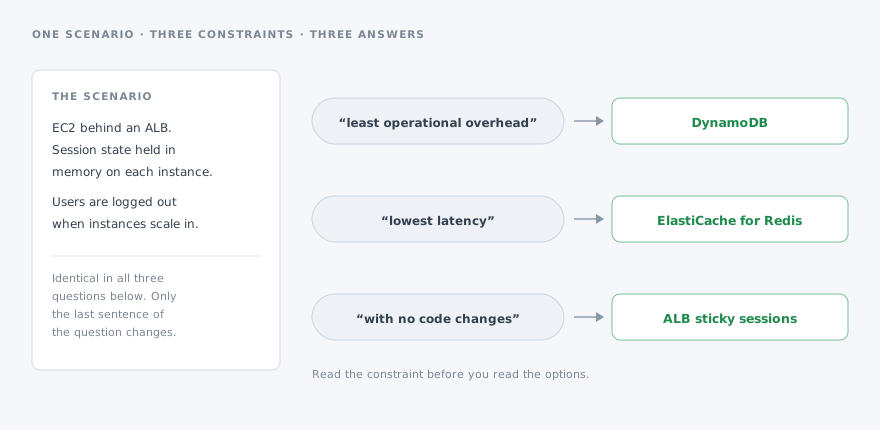
A company runs a web application on EC2 instances behind an Application Load Balancer. Session data is stored in memory on each instance, and users are being logged out when instances scale in. The company wants to fix this with the least operational overhead.
Now consider what actually works:
- Store sessions in Amazon ElastiCache for Redis — works
- Store sessions in Amazon DynamoDB — works
- Enable sticky sessions on the ALB — works, sort of, until an instance dies
- Store sessions on an Amazon EFS mount shared across instances — technically works, badly
Three of those are defensible in a real design review. Only one of them is what the exam wants, and which one it wants changes depending on the last sentence of the question. Swap "least operational overhead" for "lowest latency" and the answer moves. Swap it for "most cost-effective at low traffic" and it moves again.
This is why the highest-leverage exam skill is reading the constraint before you read the options. The scenario tells you the situation. The constraint tells you the answer.
The constraint phrases that decide questions
Learn these as a vocabulary, because they are doing more work than any service fact you will memorise:
| Phrase in the question | What it is steering you toward |
|---|---|
| "least operational overhead" / "minimal management" | Managed and serverless over self-hosted. Aurora over RDS on EC2, Fargate over EC2, SQS over self-run queues |
| "most cost-effective" | Storage tiering, Spot, reserved capacity, and shutting things off. Beware answers that are cheap but do not meet the stated requirement |
| "highest availability" / "fault tolerant" | Multi-AZ minimum, multi-region if the question mentions a region failing |
| "with no code changes" | Rules out re-architecting. Usually points at a networking or infrastructure-layer fix |
| "real time" vs "near real time" | Kinesis Data Streams vs Firehose. This distinction alone is worth several questions |
| "must be retained for N years" | Lifecycle policies, Glacier tiers, Object Lock for compliance |
When you get a practice question wrong, the useful post-mortem is rarely "I did not know that service". It is usually "I did not notice which constraint was operating."
A six-week SAA-C03 study plan
This assumes roughly 10–12 hours a week. Compress or stretch it, but keep the ordering — the sequencing is the part that matters.
Weeks 1–2: Build the mental map
Work through a structured course or the AWS Skill Builder exam prep plan, but with one rule: stop after each service and write one sentence about when you would not use it. The exam tests boundaries between services, and boundaries only become visible when you know what is on the other side.
Priority order, weighted to the domains rather than to the syllabus order:
- IAM and security — roles vs users, policy evaluation, resource-based vs identity-based policies, KMS, Secrets Manager vs Parameter Store
- VPC networking — subnets, route tables, NAT, security groups vs NACLs, VPC endpoints. This underpins questions in every other domain
- Compute — EC2 purchasing options, Auto Scaling, ECS vs EKS vs Fargate, Lambda
- Storage — S3 storage classes and lifecycle, EBS volume types, EFS vs FSx
- Databases — RDS Multi-AZ vs read replicas, Aurora, DynamoDB, ElastiCache
- Integration — SQS vs SNS vs EventBridge, API Gateway
Week 3: Build something
Two or three days of hands-on work is worth more than a week of video. Not a tutorial you follow — something small you make yourself, where you have to make the choices:
Build a VPC with public and private subnets from scratch. Put an EC2 instance in the private subnet and make it reach the internet. Put an ALB in front of an Auto Scaling group. Break it, and read the error. The reason this works is that the exam's scenarios are descriptions of things going wrong, and you recognise those descriptions much faster once you have caused them.
Stay inside the free tier and tear it down afterwards.
Weeks 4–5: Drill decision pairs, not services
This is the phase most study plans skip, and it is where the score actually moves. Instead of revising services one at a time, revise them in the pairs and triples the exam uses to trip you up:
- S3 Standard-IA vs One Zone-IA vs Glacier Instant Retrieval vs Glacier Flexible Retrieval
- EBS gp3 vs io2 vs st1 — and when the answer is "not EBS, use EFS"
- ALB vs NLB vs Gateway Load Balancer
- SQS vs SNS vs EventBridge vs Kinesis
- RDS Multi-AZ (availability) vs read replicas (performance) — this distinction is tested relentlessly
- NAT gateway vs NAT instance vs egress-only internet gateway
- Security groups (stateful) vs NACLs (stateless)
- CloudFront vs Global Accelerator
- Direct Connect vs Site-to-Site VPN vs both
For each pair, write the one sentence that decides between them. If you cannot write that sentence, you do not know the pair yet, however familiar both services feel.
Start taking scenario-based practice questions in volume during this phase — but in short scored sets, reviewing every answer including the ones you got right. A question you got right by eliminating two options and guessing between two is a question you got wrong with good luck, and it will not go your way twice.
Week 6: Full-length timed mocks
Now, and not before, take full 65-question, 130-minute mock exams. There are two reasons to leave this to the end.
The first is diagnostic: a full-length mock under time pressure is the only thing that surfaces whether your accuracy holds up in the last thirty minutes. Plenty of people are comfortably above 720 for the first forty questions and fall off a cliff after that. You cannot see that in a 10-question quiz.
The second is arithmetic: 130 minutes across 65 questions is 120 seconds per question, including reading a paragraph-long scenario and four full-sentence options. That is not much. Practising untimed builds a habit the real exam will not let you keep.
Aim to sit at least three full mocks. If you are scoring consistently above 800 on unseen questions, you have margin. If you are hovering at 720, you do not — scaled scoring means a bad question cluster can move you more than you would like.
Our SAA-C03 practice exams are built at the same 65-question, 130-minute format and report against the same 720 threshold, with a domain-by-domain breakdown so you can see whether the gap is in security, resilience, performance or cost rather than just seeing a number.
Questions people ask before booking
Is SAA-C03 hard?
It is a real step up from Cloud Practitioner, but the difficulty is not depth of recall. It is that several answers work and only one is best for the stated constraint. People with AWS experience often find it easier than they expected; people who prepared entirely by watching content often find it harder.
Do I need Cloud Practitioner first?
No. AWS removed all prerequisites, and going straight to SAA-C03 is common. CLF-C02 is worth it if the cloud is genuinely new to you, mostly because it builds vocabulary cheaply.
How many questions do I need to get right to pass?
There is no fixed number. AWS uses scaled scoring, so 720 is not "72% of questions correct" — questions carry different weight, and 15 of the 65 are unscored. Treat any practice tool that reports a raw percentage as a rough signal, not a prediction.
Should I use exam dumps?
No — and not only for the reason you are expecting. Using leaked exam content violates the AWS Certification Agreement and can get your certification revoked, which is the obvious problem. The less obvious one is that dumps train recall of specific questions, and the exam has a large enough question pool that recall does not generalise. You end up confident and unprepared, which is worse than being neither.
The one thing to take away
If you change one thing about how you are studying, make it this: stop revising services and start revising decisions.
The exam does not ask what Amazon EFS is. It describes a situation and asks whether EFS or FSx or S3 is the right answer given a constraint. Every hour you spend practising that specific judgement is worth several hours spent building broader familiarity you will never be asked to demonstrate.