How to prepare for AWS Cloud Practitioner (CLF-C02): a two-week study plan
How long it takes to prepare for the AWS Certified Cloud Practitioner, what the CLF-C02 passing score of 700 actually means, and the service pairs that catch most people out. A two-week study plan for the exam that is easy in theory and precise in practice.
- AWS
- Certification
- CLF-C02
- Study plan
The AWS Certified Cloud Practitioner has a reputation problem. It is described everywhere as the easy one, the entry-level one, the one you can pass in a weekend. And then roughly a quarter of the people who sit it do not pass.
Both things are true, and the gap between them is the whole story. CLF-C02 is not a difficult exam. It is a precise one. The concepts are shallow — nobody is asking you to design anything. But the questions are built almost entirely out of distinctions between things that sound similar, and "sounds similar" is exactly what a weekend of video content leaves you with.
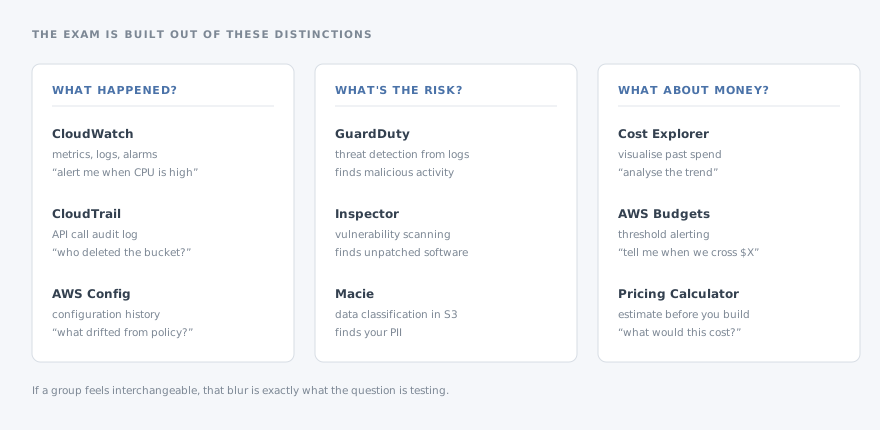
If you can confidently say what the difference is between CloudTrail and CloudWatch and Config, between GuardDuty and Inspector and Macie, and between a Savings Plan and a Reserved Instance, you are most of the way there. If those trios feel like a blur, that blur is what the exam is testing.
How long does it take to prepare for CLF-C02?
| Your background | Realistic preparation time |
|---|---|
| Working in or near AWS already | 3–7 days |
| General IT, dev, or another cloud | 1–2 weeks |
| Non-technical — sales, finance, PM, support | 3–4 weeks |
| No IT background at all | 4–6 weeks |
For most people it is 15 to 30 hours in total. The people at the long end of that range are usually not struggling with difficulty — they are building vocabulary from zero, which simply takes time.
This exam is unusual in that a large share of candidates are not engineers. Account managers, recruiters, finance staff and project managers take it to be able to talk about cloud accurately with their engineering teams. If that is you, the good news is that nothing in the exam requires you to build anything. The bad news is that you cannot lean on intuition from having used the services, so the naming distinctions have to be learned deliberately.
What is on the CLF-C02 exam?
65 questions in 90 minutes, scored 100 to 1000, with 700 to pass. Fifteen of the 65 are unscored trial questions, leaving 50 that count.
| Domain | Weight | Rough share of questions |
|---|---|---|
| Cloud Technology and Services | 34% | ~22 |
| Security and Compliance | 30% | ~20 |
| Cloud Concepts | 24% | ~16 |
| Billing, Pricing and Support | 12% | ~8 |
Two-thirds of the exam sits in Technology/Services and Security/Compliance. If your study time is limited, that is where it belongs — and note that security is nearly a third of the exam, which surprises people who assumed a foundational certification would be mostly service names.
The exam is 90 minutes for 65 questions, which is 83 seconds per question. That sounds tight but is not, in practice: the questions are short. Most people finish with time to spare. Time pressure is not this exam's difficulty.
The distinctions that decide the exam
This is the highest-value section of any CLF-C02 preparation, and it is worth more than any amount of broad reading. Learn these groups as groups.
Monitoring, logging and configuration
- CloudWatch — metrics, logs, alarms. Performance and health. What is happening?
- CloudTrail — API call audit log. Who did what, when. Who did this?
- AWS Config — resource configuration history and compliance rules. What does this look like now versus before?
The question shape is always "an auditor needs to know who deleted the bucket" (CloudTrail) or "you need alerting when CPU is high" (CloudWatch) or "you need to know which resources drifted from policy" (Config).
Security services
- GuardDuty — threat detection from logs. Finds malicious activity
- Inspector — vulnerability scanning of EC2, containers and Lambda. Finds unpatched software
- Macie — discovers and classifies sensitive data in S3. Finds your PII
- Security Hub — aggregates findings from the above into one place
- WAF — filters web traffic at layer 7. Shield — DDoS protection at layers 3/4
- Trusted Advisor — best-practice checks across cost, performance, security, fault tolerance and limits
Cost management
- Cost Explorer — visualise and analyse past spend
- AWS Budgets — alert me when spend crosses a threshold
- Cost and Usage Report — the raw, detailed data export
- Pricing Calculator — estimate before you build
- Compute Optimizer — right-sizing recommendations
"Alert" means Budgets. "Analyse trends" means Cost Explorer. "Estimate a future workload" means Pricing Calculator.
Purchasing options
- On-Demand — no commitment, highest per-hour price
- Reserved Instances — 1 or 3 year commitment to specific instance attributes
- Savings Plans — 1 or 3 year commitment to a dollar-per-hour spend, more flexible than RIs
- Spot — spare capacity, up to ~90% off, can be interrupted. Only for fault-tolerant work
- Dedicated Hosts — physical server, usually for licensing compliance
Support plans
Worth memorising outright, because these questions are free marks if you know the table and pure guesswork if you do not:
| Plan | Technical support | Critical response time |
|---|---|---|
| Basic | None (customer service only) | — |
| Developer | Business hours, email | General guidance < 24h |
| Business | 24/7 phone, chat, email | Production down < 1h |
| Enterprise On-Ramp | 24/7, pool of TAMs | Business-critical down < 30 min |
| Enterprise | 24/7, designated TAM | Business-critical down < 15 min |
The two facts most often tested: a designated Technical Account Manager comes with Enterprise, and 24/7 technical support starts at Business.
The shared responsibility model
This deserves its own section because it is the single most tested concept on the exam, appearing across the whole Security and Compliance domain.
The shortest correct summary: AWS is responsible for security of the cloud. You are responsible for security in the cloud.
| AWS is responsible for | You are responsible for |
|---|---|
| Physical data centres | Your data, and classifying it |
| Hardware and the global infrastructure | Operating system patching on EC2 |
| Virtualisation layer | Network and firewall configuration |
| Managed service infrastructure | IAM users, roles and permissions |
| Client and server-side encryption |
The nuance that catches people: the line moves depending on the service. On EC2 you patch the operating system. On RDS, AWS patches it. On Lambda, there is no operating system for you to think about at all. Questions exploit exactly this — "who is responsible for patching the guest OS" has a different answer for EC2 than for RDS, and the exam knows it.
If you learn one thing thoroughly for CLF-C02, learn this model and how it shifts across the compute spectrum.
A two-week CLF-C02 study plan
Roughly 2 hours a day. Compress to one intense week if you already work near AWS.
Days 1–3 — Cloud concepts and the global infrastructure. Why cloud, the six advantages, capital versus operating expenditure, economies of scale. Then Regions, Availability Zones, edge locations and Local Zones — and specifically the relationship between them, since "how many AZs make a Region" style questions are common. Skim the Well-Architected Framework pillars.
Days 4–6 — Core services, breadth first. Compute (EC2, Lambda, ECS, Elastic Beanstalk), storage (S3 and its classes, EBS, EFS, Glacier), databases (RDS, Aurora, DynamoDB, Redshift), networking (VPC, Route 53, CloudFront, Direct Connect). One line each on what problem it solves. Do not go deep — depth is not tested, breadth is.
Days 7–9 — Security, IAM and the shared responsibility model. The biggest single block of study time relative to its size, because it is 30% of the exam and the least intuitive. IAM users, groups, roles and policies; MFA; the root account and what you should never do with it; the security services listed above; compliance programmes and AWS Artifact.
Days 10–11 — Billing, pricing and support. The tables above. This domain is only 12% of the exam but it is the most memorisable — the marks here are the cheapest on the paper.
Days 12–14 — Practice exams and gap-closing. Take full 65-question, 90-minute mocks. Review every single answer, including correct ones. When you get something wrong, do not just note the right answer — write down which service you confused it with, because that pair is now on your revision list.
Our CLF-C02 practice exams run at the real 65-question, 90-minute format and score against the same 700 threshold, with a domain breakdown so you can see whether the gap is in security, services, concepts or billing before you book the real thing.
Book the exam when you are consistently over 800 on unseen mocks. Not 700 — 800. You want margin, because exam-day nerves are real and scaled scoring is not perfectly predictable.
Common questions
Is AWS Cloud Practitioner hard to pass?
Not conceptually. But it is not a formality either, and the people who fail almost always did so by confusing similar services rather than by hitting anything genuinely difficult. Treat it as an exam that rewards precision rather than depth.
What is the minimum passing score for CLF-C02?
700 out of 1000, on a scaled score. Because scoring is scaled and 15 questions are unscored, 700 does not map cleanly to "70% of questions right".
Is AWS Cloud Practitioner worth it?
For non-engineers working around cloud teams, it is genuinely useful — it buys you accurate vocabulary cheaply, and $100 is a low price for being able to follow architecture conversations. For engineers intending to go further, it is optional; many go straight to an associate exam. It is not, on its own, a certification that changes hiring outcomes for technical roles.
How long is the certification valid?
Three years. AWS will prompt you to recertify, and passing any higher-level exam also renews it.
Should I use practice questions or exam dumps?
Practice questions, written to match the exam's style. Dumps are leaked real exam content — using them breaches the AWS Certification Agreement and can cost you the certification. They also train you to recognise specific questions rather than to make the distinctions the exam is built on, which is precisely the skill you need here.
The takeaway
Do not prepare for Cloud Practitioner by trying to learn more AWS. Prepare by learning to tell similar things apart.
Make a list of every group of services that feels interchangeable to you, and work through it until you can write the one sentence that separates each from its neighbours. That list is short — maybe fifteen groups — and it is very close to being the exam.